Kincade's files
Bound by DarknessKincade's files are the records through which Sasha Willis and the Seattle Paladins begin to convert suspicion about Colonel Kincade into a provable network of theft, concealment, and institutional complicity. What first appears to be an administrative mess becomes a material map of power: phantom payroll entries, encrypted computer data, offshore accounts, transfers connected to St. Louis, and evidence that Kincade used hostility between departments to keep the Seattle sector unstable. The files therefore matter not merely as evidence against a disgraced administrator, but as the object that reveals how money, information, prejudice, and violence have been made to reinforce one another.
Discovery in the Administrative Records
Sasha Willis encounters the first decisive clue while reviewing the Paladin financial records left behind by Kincade. Salaries had been authorized for three additional Paladins, yet the supposed employees appeared on no duty rosters and had no discoverable personal information. She concludes that these were not ordinary accounting errors or nonexistent workers, but Kalith warriors who had crossed from another world and were being sheltered by the Seattle Paladins. The discovery is especially explosive because the payments were being made from Regent funds, turning the presence of the Kalith from a secretive local arrangement into a possible case of financial misconduct.
The records also sharpen Sasha's anger at the human cost behind the entries. The Seattle Paladins were widely believed to be sheltering dangerous Others, and guards had died in the continuing violence surrounding the sector. George later reports that another guard nearly killed one of the Kalith, treating the failed killing as an unfortunate missed solution rather than a tragedy. Against that atmosphere, the files do more than identify unauthorized spending: they show that institutional money has been attached to a contested policy of protection while opponents describe the protected people as enemies and parasites.
Computer Evidence and the Money Trail
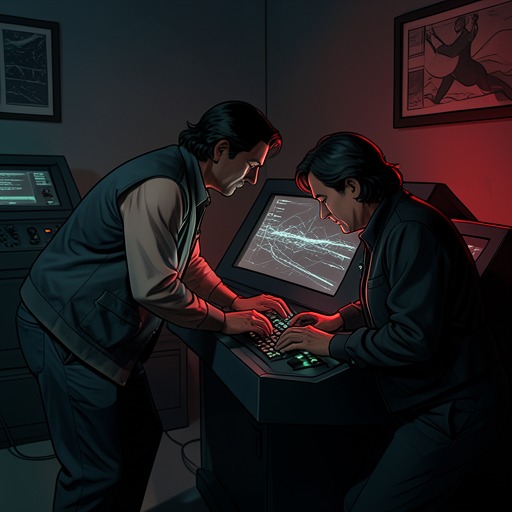
Because Kincade had hidden his tracks so effectively, Sasha borrows D·J· Clayborne from Devlin Bane to examine Kincade's personal computer. D·J. initially works with his customary playfulness, but the search changes tone when he discovers Kincade's offshore bank accounts. He calls Cullen Finley for assistance, since Cullen is particularly skilled at tracing financial movements, and the two computer specialists begin following the transfers rather than treating the files as a closed record of Kincade's individual crimes.
The first electronic lead points toward the Regents' server in St. Louis. D·J. cautions that the route could be a false trail because Kincade was adept at disguising his movements, but the uncertainty does not erase the significance of the connection. Later, Cullen confirms that deposits do lead back to St. Louis, making it clear that Kincade was not acting entirely alone. The files thus change the scale of the investigation: what began as an audit of a Seattle administrator becomes an inquiry into whether officials beyond the local sector participated in, benefited from, or concealed the theft.
What the Files Reveal About Kincade's Rule
Sasha's fuller account describes a sustained pattern rather than a single embezzlement. Kincade had taken money from every account he could access and manipulated the numbers to conceal the withdrawals. Over the years, the stolen amount reached hundreds of thousands of dollars. He also deliberately aggravated the divisions among the departments in the region, keeping them suspicious and antagonistic toward one another. His treatment of the Paladins was so abusive that an open rebellion had nearly become possible.
The files therefore preserve the economic and political dimensions of the same governing method. Kincade extracted money through falsified records while extracting obedience through conflict. His handling of the Kalith was part of that larger system: the records indicate that he allowed them to buy their way into the human world, and the later investigation shows that he was simultaneously stealing directly from the Regents. Most of the money appears to have remained with Kincade, while the remainder moved into offshore accounts leading back to the Midwest Region. The distinction between personal enrichment and organized collaboration remains important, because the documents suggest both a private fortune and a broader channel of complicity.
Political Consequences and Continuing Danger
The files place Sasha in a dangerous position. She needs Devlin Bane's support to stabilize the region, yet exposing the evidence could bring charges of treason and theft against him if he is treated as a Paladin leader who has acted outside Regent authority. Sasha initially withholds her findings because removing Devlin would risk throwing an already unruly Seattle sector into deeper disorder. Chaz Willis, her father and a Regent, is likewise kept waiting for details until she is prepared to present the case formally to the Board of Regents.
When Sasha finally explains the findings to Chaz, he reacts with disbelief at the suggestion that money from Kincade's accounts could lead into the Midwest administration. She makes clear that she does not suspect him personally, but she cannot rule out what Devlin Bane may think or what the money trail may uncover. D·J. and Cullen's continuing work on Kincade's encryption offers the possibility of identifying the accomplices rather than merely proving that transfers occurred. The files consequently become both a shield and a liability: they can protect Sasha's accusations from being dismissed as rumor, but they can also destabilize the hierarchy that must decide what to do with them.
That danger persists when an unidentified caller demands Kincade's account numbers and the money taken from him. Sasha refuses the premise that the money belongs to Kincade or to the caller, while the threat against her father makes the records part of an active struggle rather than a completed investigation. Their value lies not only in what they already prove, but in the further names, routes, and relationships that may be extracted from them. As an object in the narrative, Kincade's files transform hidden corruption into an advancing threat: the more clearly the documents map the system, the more urgently those implicated in it have reason to recover or suppress them.
Narrative Significance
Kincade's files give physical and digital form to the novel's conflict over legitimacy. Public rumors claim that the Paladins are consorting with enemies, that the Kalith are dangerous intruders, and that Kincade may have been right to oppose them. The records reverse that moral framing by showing that the administrator who cultivated division was himself stealing from the institution and routing funds through concealed accounts. At the same time, they do not make every local decision automatically innocent: the phantom salaries and secret protection of Kalith warriors remain politically consequential, especially in a region where guards have been killed and anti-Kalith sentiment is spreading.
The files are thus an instrument of truth that does not simplify the world it enters. They connect bureaucratic details to bodies in danger, private profit to public disorder, and local prejudice to distant administrative channels. Their narrative force comes from that accumulation. A salary line leads to a hidden population; an encrypted computer leads to offshore accounts; an offshore account leads toward St. Louis; and the resulting chain threatens to implicate an entire governing structure rather than one corrupt man.